
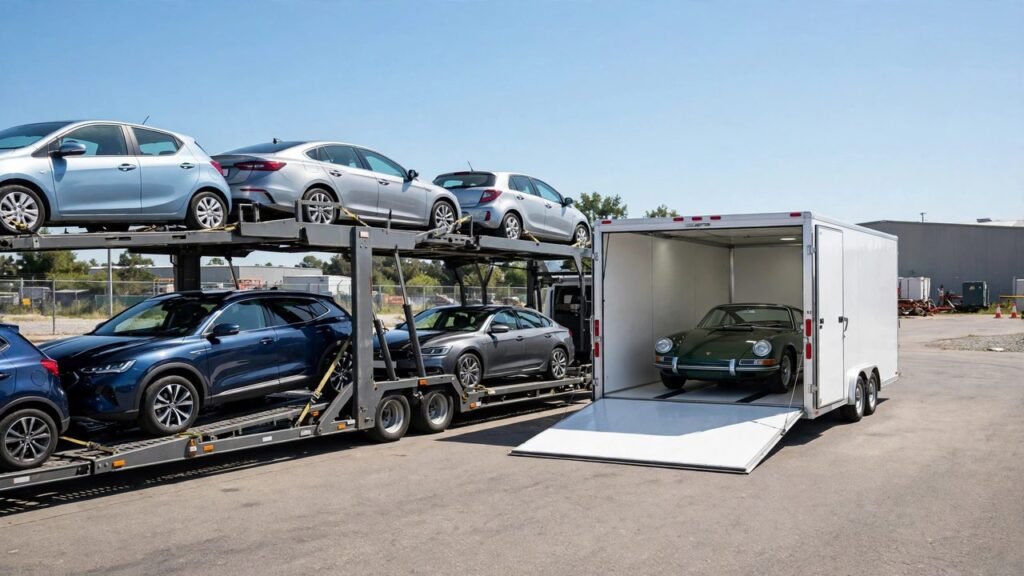
Open vs Enclosed Auto Transport: Which One Should You Pick?
One of the first choices you will make when shipping a car is also one of the most confusing: open or enclosed transport? The price difference is real, often hundreds of dollars, and every company seems to have an opinion. Here is the honest breakdown so you can pick with confidence.
What open transport actually is
Open transport is the standard way cars move around America. Your car rides on an open trailer, usually a double-decker carrier holding seven to ten vehicles, exposed to the weather and road dust just like it would be on the highway. About 90 percent of all cars shipped in the US travel this way.
There is nothing sketchy about it. These are the same trailers you see on every interstate, operated by professional drivers who load and unload cars all day. Damage rates are low, and every licensed carrier carries cargo insurance.
What enclosed transport actually is
Enclosed transport puts your car inside a covered trailer with walls and a roof. The car is protected from rain, snow, road debris, and prying eyes. Enclosed trailers usually carry fewer vehicles, often two to six, and many have lift gates instead of ramps for low-clearance cars, plus soft tie-downs that never touch the paint the wrong way.
You pay a premium for this: typically 40 to 60 percent more than open transport on the same route. On a $1,000 open shipment, expect enclosed to run $1,400 to $1,600.
Side by side comparison
- Cost: Open is 40 to 60 percent cheaper. Enclosed is a premium service.
- Protection: Enclosed shields against weather, dust, and debris. Open exposes the car to the elements.
- Availability: Open carriers are everywhere, so pickup is usually faster. Enclosed trailers are fewer, so scheduling can take longer.
- Capacity: Open trailers carry 7 to 10 cars. Enclosed trailers carry 2 to 6.
- Ideal for: Open suits daily drivers. Enclosed suits high-value, classic, exotic, and show cars.
When open transport is the right call
For most people, most of the time, open transport is the right answer. If you drive a standard sedan, SUV, or truck that already lives outside in your driveway, open shipping changes nothing about what your car experiences. It gets rained on in your driveway too.
Open is also the better choice when timing matters. Because open carriers are so common, you will usually get picked up faster and have more scheduling flexibility. And of course, it costs significantly less, which is reason enough when the car does not need extra protection.
When enclosed transport is worth the money
Enclosed earns its premium in specific situations. Ship enclosed if your car is a classic, collector, exotic, or luxury vehicle where paint condition directly affects value. A single paint chip on a vintage Porsche costs more to fix than the enclosed upcharge.
Also consider enclosed for brand-new cars you want arriving in showroom condition, for low-clearance sports cars that need a lift gate, for custom paint jobs and restorations, and for winter shipments through harsh weather corridors. If the thought of road grime on your car genuinely bothers you, that peace of mind has value too.
For realistic numbers, see our full 2026 price guide, which includes enclosed ranges by distance.
Common myths about open transport
“Open carriers damage cars all the time”
Not true. Damage claims are rare relative to the millions of cars shipped yearly. Cars get dirty, yes, but a wash fixes that. Real damage is uncommon and usually minor.
“Enclosed is always safer”
Mostly true for weather and debris, but enclosed trailers are not magic. Cars can still shift if loaded poorly, which is why the operator’s skill matters more than the trailer type. A careful open carrier beats a careless enclosed one.
“My car is too nice for open transport”
Maybe, maybe not. A three-year-old BMW that you park outside every day will be perfectly fine on an open trailer. Reserve enclosed for cars where condition equals money: classics, exotics, and show vehicles.
How to decide in 60 seconds
Ask yourself two questions. First: would a paint chip or a week of road dust cost me real money or real distress? If yes, go enclosed. Second: is my car worth more than about $70,000, or is it irreplaceable? If yes, go enclosed. If you answered no to both, open transport will serve you well and save you hundreds.
Still unsure? The cost estimator lets you compare open and enclosed pricing for your route before you talk to any company. And when you are ready to book, our step by step guide walks through the whole process.
Soft-side vs hard-side enclosed trailers
Not all enclosed trailers are equal. Hard-side enclosed trailers have solid metal walls, the maximum protection you can get on the road. Soft-side trailers have canvas or vinyl sides over a frame: they block most weather and debris but not everything, and they usually cost a bit less than hard-side.
For most classic and luxury cars, soft-side is plenty. Reserve hard-side for concours-level vehicles, irreplaceable prototypes, or cars worth deep into six figures. When a company quotes you enclosed, it is worth asking which type they run. The price difference between soft and hard side is usually modest, but the protection difference matters for truly special cars.
Questions to ask before you choose
Whichever way you lean, ask the company these questions before booking. The answers tell you a lot about how professional the operation is. You can also verify any carrier’s insurance and safety record yourself on the FMCSA SAFER database.
- Is your quote for open or enclosed, and is that confirmed in writing?
- What are the cargo insurance limits on the assigned carrier?
- How will my car be secured: wheel straps, chains, or soft ties?
- What is the pickup window, and what happens if the truck runs late?
- Can I track the shipment or contact the driver directly?
Vague or evasive answers are a red flag regardless of trailer type. A good company answers these without hesitation. If you want to dig deeper into vetting companies, our guide on brokers vs carriers explains who you are actually dealing with, and how to compare quotes shows you how to read the fine print.
Frequently asked questions
Is enclosed car shipping really safer?
For weather, dust, and road debris, yes. For overall damage risk, the difference is smaller than marketing suggests, because most damage comes from loading errors, which depend on the driver, not the trailer. Choose a reputable company either way.
Can I ship a convertible on an open carrier?
Yes, as long as the top is secured and the car is weather-ready. Convertibles ship on open carriers every day. If the top is fragile or the car is a valuable classic convertible, enclosed is the safer bet.
How much more is enclosed vs open transport?
Typically 40 to 60 percent more. On a $1,000 open quote, expect $1,400 to $1,600 for enclosed. The gap widens on less popular routes where enclosed carriers are scarce.
Do enclosed trailers have insurance too?
Yes. Enclosed carriers must carry cargo insurance just like open carriers, and many carry higher limits because of the vehicle values they handle. Always confirm the coverage amount in writing. Our insurance guide explains what to check.
Will my car get dirty on an open trailer?
Almost certainly, yes. Expect dust and road film, like after a long highway drive. A basic wash on delivery takes care of it. If that bothers you more than the price difference, enclosed is calling your name.