
How Much Does It Cost to Ship a Car in 2026: Full Price Guide
If you are shipping a car for the first time, the price is usually the first thing you want to pin down, and the hardest number to get straight. One company quotes $800, another quotes $1,400 for the same trip, and neither explains why. This guide gives you real 2026 price ranges, shows what moves the numbers, and helps you tell a fair quote from a fantasy.
Prices below are typical ranges for standard sedans on open trailers, based on current market rates. Your quote will vary with route, season, and vehicle, but these numbers will keep you grounded.
Typical car shipping prices in 2026
For a standard sedan on an open carrier, here is what most people actually pay:
- Under 500 miles: $450 to $750
- 500 to 1,000 miles: $700 to $1,100
- 1,000 to 1,500 miles: $900 to $1,300
- 1,500 to 2,000 miles: $1,000 to $1,500
- Over 2,000 miles (coast to coast): $1,100 to $1,700
Notice that the per-mile rate drops as distance grows. A 300-mile trip might cost $2 or more per mile, while a 2,500-mile trip often lands under $0.70 per mile. Short trips are expensive per mile because the fixed costs of pickup, loading, and scheduling get spread over fewer miles.
Enclosed transport typically adds 40 to 60 percent on top of these ranges. SUVs, trucks, and modified vehicles usually add $100 to $300 because they take more space and weight.
What actually determines your price
Seven factors do most of the work. Understand these and no quote will ever confuse you again.
1. Distance
Distance is the biggest driver, but not in a straight line. The first few hundred miles are the priciest per mile. After that, each extra mile gets cheaper. This is why a 400-mile shipment can cost nearly as much as an 800-mile one.
2. Route popularity
Busy corridors between major cities cost less. Carriers want full trailers, so routes like Los Angeles to Dallas or Florida to New York have steady demand and competitive pricing. Shipping to or from a rural town costs more because the driver has to go out of the way, sometimes adding 100 miles of deadhead driving just to reach you.
3. Vehicle size and weight
A Honda Civic costs less to ship than a Ford F-150. Larger vehicles take more trailer space and add weight, which burns more fuel. Oversized vehicles like lifted trucks may need special placement and cost extra. If your car does not run, expect a winch fee of $100 to $200 since loading takes more time and equipment.
4. Open vs enclosed trailer
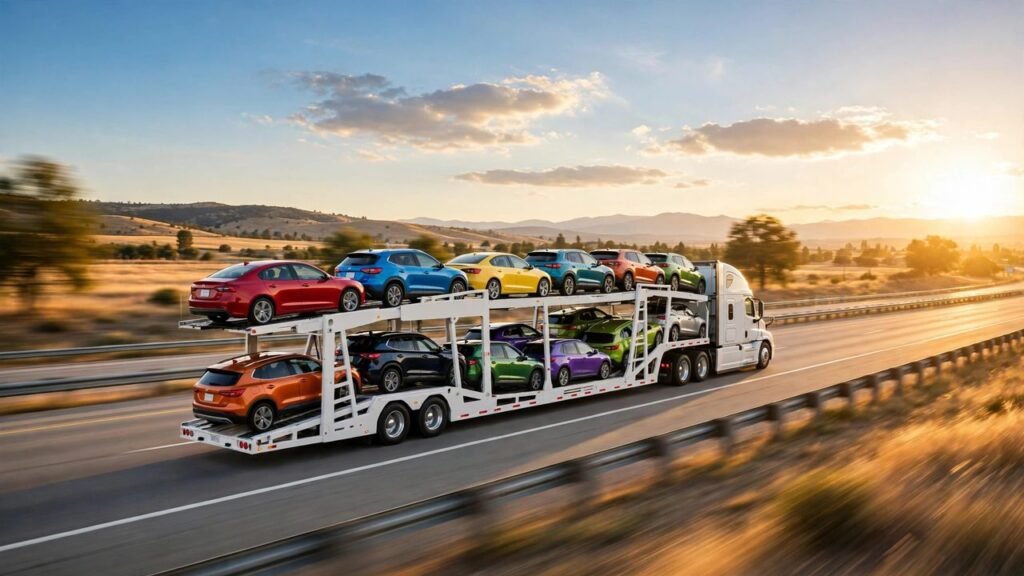
Open carriers are the standard: your car rides on an open trailer with up to nine other vehicles. It is safe, common, and the cheapest option. Enclosed trailers protect the car from weather and road debris inside a covered trailer, and they cost 40 to 60 percent more. For most daily drivers, open transport is the sensible pick. Our open vs enclosed guide walks through the decision in detail.
5. Season and timing
Car shipping has seasons, just like airlines. Summer is peak season: families move, students relocate, and prices run 15 to 25 percent higher. January through March is usually cheapest. Snowbird season (October through December) spikes prices on north-to-south routes. If your dates are flexible, timing alone can save you a few hundred dollars. See our month by month price guide for the full picture.
6. Pickup and delivery type
Door to door service, where the truck comes as close to your addresses as legally possible, is standard and usually included. Terminal to terminal can be cheaper but means dropping off and picking up your car at a storage lot, sometimes far away. For most people, the small savings are not worth the hassle.
7. How fast you need it
Standard shipping gives the carrier a pickup window of a few days. Expedited service guarantees faster pickup, often within 24 to 48 hours, and costs 20 to 40 percent more. Only pay for speed if your dates truly demand it.
Real price examples by route
To make this concrete, here are realistic 2026 ranges for popular routes with a standard sedan on an open trailer:
- Los Angeles to Dallas (1,435 miles): $900 to $1,200
- New York to Miami (1,280 miles): $800 to $1,100
- Chicago to Los Angeles (2,015 miles): $1,100 to $1,400
- Seattle to San Diego (1,130 miles): $800 to $1,050
- Boston to Atlanta (1,070 miles): $750 to $1,000
- Coast to coast, New York to Los Angeles (2,790 miles): $1,200 to $1,700
Add 40 to 60 percent for enclosed transport on any of these. Add $100 to $300 for a large SUV or truck.
How to get an accurate quote
A real quote needs your exact pickup and delivery ZIP codes, vehicle year/make/model, whether it runs, your preferred dates, and open vs enclosed. Anyone quoting without these details is guessing. Collect three to five quotes from different companies, and compare them the right way: our guide on how to compare car shipping quotes shows what to look for beyond the bottom-line number.
Want a quick ballpark before you start calling around? Our car shipping cost estimator walks you through a 60-second estimate so you know what range to expect.
Watch out for quotes that seem too good
Here is the industry’s open secret: some brokers quote low on purpose to win your deposit, then raise the price later when no carrier accepts the job. This is the classic bait and switch. A quote far below everyone else is not a bargain; it is a warning sign. Legitimate quotes cluster together. If four companies say $1,100 and one says $700, the $700 quote is the one to distrust.
You can protect yourself by checking every company’s credentials before you book. Look up their MC number on the FMCSA SAFER database, which is the federal registry of licensed carriers and brokers. No MC number, no booking. It takes two minutes.
Frequently asked questions
What is the cheapest way to ship a car?
Ship a standard sedan on an open carrier, between major cities, in the off season (January to March), with flexible pickup dates. Each of those choices trims the price, and together they can save 20 to 30 percent.
Does car shipping price include insurance?
Yes. Licensed carriers are required to carry cargo insurance, and basic coverage is included in your quote. It covers damage caused during transit, not pre-existing damage. Read our car shipping insurance guide to understand what is covered and what is not.
Why do quotes vary so much between companies?
Some variance is normal: different companies have different carrier networks and margins. But large gaps usually mean someone is lowballing to win your business, or quoting a different service level (open vs enclosed, standard vs expedited). Compare line by line, not just the total.
Do I pay upfront or on delivery?
Most brokers take a small deposit or partial payment when your car is assigned to a carrier, with the balance due on delivery, often in cash or certified funds to the driver. Be cautious of any company demanding full payment upfront before a carrier is assigned.
Is it cheaper to drive the car myself?
Sometimes, for short trips. For long distances, add up fuel, hotels, food, wear and tear, and your time, and shipping usually wins. Our step by step shipping guide covers the full process so you can decide with real numbers.
Shipping a car does not have to be a gamble. Get a few honest quotes, check the company’s credentials, and time it well, and you will pay a fair price for a smooth move.